


- About
-
-

- About
-
ACGIH is a 501(c)(3) charitable scientific organization that advances occupational and environmental health.
-
-
- Subscriptions
-
-
-
Get valuable benefits that are vital to your health and safety as an occupational, environmental, health, and safety worker.
-
-
- Science
-
-
- Science
-
This section has been established to help educate industry, government, and the public on what TLVs and BEIs are, and how TLVs and BEIs may best be used.
-
-
- Career Development
-
-
- Career Development
-
ACGIH is committed to providing its members and other occupational and environmental health professionals with the training and education they need to excel in their profession.
-
-
- Publications
-
-
- Publications
-
ACGIH has publications in many different areas that fit your needs in your field.
-
- Publications Store
ACGIH Digital Library
If you need to purchase the Digital Library, click here.
If you have purchased and need to access the Digital Library, click here.
-
-


In-Person Course
Noise Control for Industrial Hygienists
April 20-22, 2027
Greater Cincinnati Area
Earn 18 Education Contact Hours
Course Description
This course is designed to give Industrial Hygienists and Safety Professionals practical knowledge about noise control concepts and methods that will help them to assess hearing conservation challenges and develop “engineering controls” to reduce noise exposure.
Overview
Sound is a common experience, so common that we can be lulled into a casual approach to understanding it. Myths, misunderstandings, magical thinking, and oversimplifications are an unfortunate consequence. Precise terminology, useful data, and comprehensive, practical training are harder to come by. When “engineering controls” are needed, Industrial Hygienists are often thrown into “the deep end” because they are responsible for noise dosimetry – which defines the problem but not the solution.
Success in noise control often appears like magic – it’s as if there’s some secret society that guards the know-how like a medieval guild. The truth is that this know-how typically isn’t taught at universities but is too complex for the average person to figure out on their own.
This course is intended to address this situation and prepare you for success.
You’ll learn how sound gets created and how it travels. You’ll learn what decibels really are, in their many flavors. You’ll learn that hearing defies physics and that perception and sound level meters don’t always agree. You’ll learn how noise can be controlled, including strategies for deciding where to start, what to do, and how to manage expectations.
You’ll learn all this in three days making use of audio demonstrations, practice measurements, high school math, worked examples, and plain language.
Instructor
David A. Nelson, INCE Fellow/Board Certified, Principal Consultant, Nelson Acoustics
Rates
Subscriber Price: $1,999
Non-Subscriber Price: $2,299
Note: This course must be purchased by the person who will be accessing and taking the class.
On Demand Webinars
Center for Disease Control and Prevention (CDC) Efforts to Promote Total Hearing Health
Hearing Protector Fit Testing: Past, Present, and Future
Noise Factors for OEHS and Industrial Hygiene
Understanding and Addressing Community Noise
Worldwide Noise Control Options Database Access – Simplifying Risk Reduction
On Demand Professional Development Course
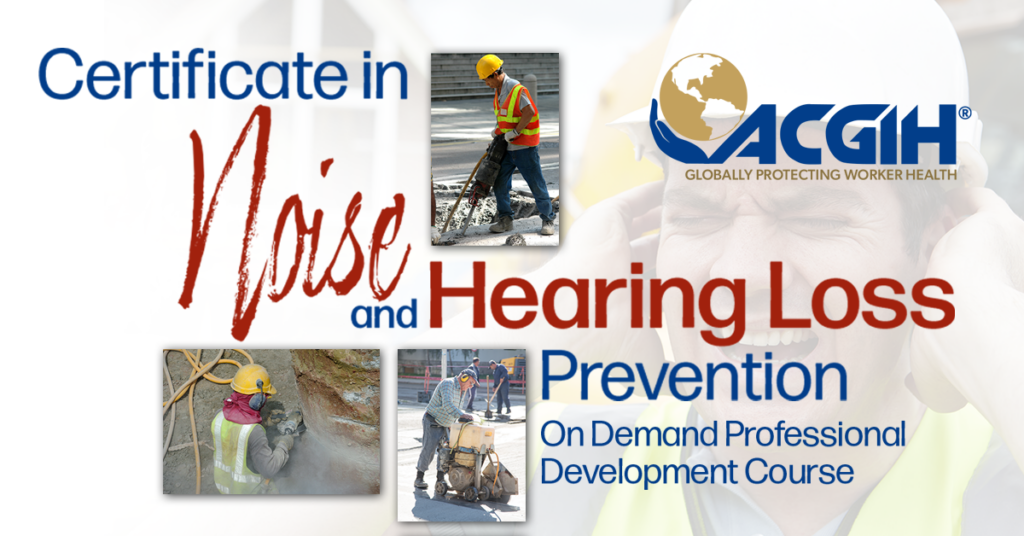
Certificate in Noise and Hearing Loss Prevention
Earn 7 Education Contact Hours at your Convenience!
Course Description
You may know that noise exposure is a ubiquitous workplace hazard in the US and globally, and that noise-induced hearing loss is one of the most common occupational diseases. However, did you know that occupational noise has also been linked to high blood pressure and injuries? Or that the Occupational Safety and Health Administration’s limit for noise is not very protective against noise-induced hearing loss? This certificate course explores the basics of noise, auditory and non-auditory health impacts of noise, noise measurement instrumentation and methods, relevant exposure limits and guidelines (including the ACGIH® TLVs® for Audible Sound, Infrasound, and Ultrasound), hearing loss prevention programs, noise controls, and hearing protection devices. Learners can also choose to learn about ototoxic exposures (that is, chemical agents that can harm hearing even in the absence of noise), hearing protector fit testing, and community noise assessment. Practical and real-world examples are included throughout the course to reinforce key concepts. Technical readings are tied to each topic to allow learners to explore concepts in greater detail.
Instructor: Richard L Neitzel, PhD, CIH, FAIHA
Rick Neitzel is a Professor of Environmental Health Sciences and Global Public Health at the University of Michigan (UM) School of Public Health. He has published more than 130 peer-reviewed manuscripts focused on exposures to, and impacts of, noise and other occupational and environmental hazards. He is particularly interested in incorporating new methodologies and exposure sensing technologies into research and has a strong interest in translating his research findings into occupational and public health practice. He has created a job-exposure matrix for occupational noise exposures in the U.S. and Canada (https://noisejem.sph.umich.edu). He also serves as the principal investigator of the Apple Hearing Study, a nationwide study of sound exposures and their impacts on hearing health (https://sph.umich.edu/applehearingstudy/). Dr. Neitzel is Chair of the ACGIH Threshold Limit Values for Physical Agents (TLV-PA) Committee. He is also a Fellow of the American Industrial Hygiene Association and has been a Certified Industrial Hygienist since 2003.
Rates:
Subscriber Price: $369
Non-Subscriber Price: $459
Note: This course must be purchased by the person who will be accessing and taking the class.
Documentation
Audible Sound: TLV(R) Physical Agents 8th Edition Documentation
Purchase PDF | Data Hub (Subscribers only)
Infrasound and Low-frequency Sound
Purchase PDF | Data Hub (Subscribers only)
Ultrasound: TLV(R) Physical Agents 8th Edition Documentation
Purchase PDF | Data Hub (Subscribers only)

Enjoy exclusive benefits including free and discounted publications, conferences and continuing education courses – all while supporting the TLVs® and BEIs®.
Publications
Guide for the Control of Audible Sound Hazards
Downloadable Publication
This book is a downloadable only guide published by ACGIH and the Threshold Limit Values for Physical Agents (TLV-PA) Committee. This guide is designed to provide additional guidance for users of the Threshold Limit Value (TLV) for occupational exposure to audible sound, which recommends levels of exposure and conditions under which it is believed that nearly all healthy workers may be repeatedly exposed, day after day, without adverse health effects. It is important that this TLV be applied only by individuals adequately trained and experienced in the necessary measurement and evaluation techniques.